Running an academy is two problems, not one. The first is whether the program is any good. The second is whether anyone signs up — and that one decides whether the first ever gets built. I ran both. Every piece on this page sold a course I had also designed, and most of the persuasion happened before anyone saw an ad.
Nobody signs up because a syllabus is well structured. They sign up when they believe a specific thing about their own life is going to change — and almost nobody believes that the first time they hear about a course.
So the work starts before any copy exists: what real need does this course actually fill, for whom, and what are they afraid of. Everything after that is sequence — the organic post that makes someone curious, the page that answers the objection they haven't voiced yet, the retargeting ad that catches them a week later, the email flow that keeps arguing while they think about it, the chatbot that answers the one question stopping them. Even the syllabus is written to sell: not a list of topics, but a list of things you'll be able to do.
This matters just as much inside a company as it does in a school. Corporate academies have the same problem in a harder form: the training is optional, nobody's paying for it, and it competes with a full workload. An internal program with no one enrolled fails for exactly the reasons a course with no one enrolled fails — and it's usually fixed by the same craft.
Organic content that earns attention before it asks for anything. At Grow this built a 72,000-person audience that became the top of the funnel.
Web copy, course pages and the program itself, written around benefits and objections rather than modules.
Paid campaigns and retargeting on Meta and Google — the same person, met again with a different argument.
Automated email flows and conversational funnels that keep making the case while someone decides.
The trailer. A course is an abstraction until someone sees what four months of it looks like — the same reason a training program inside a company needs more than an intranet page announcing it.
Organic content. The top of the funnel: useful on its own, and free to anyone who never enrolls.
The document the whole sequence exists to deliver. 21 modules, 200+ lessons, written to be persuasive as well as accurate.
Full translation, English ↗ The live course page ↗A career track cost around US$100. In Argentina that is real money, and the decision takes days or weeks — so the job of the sequence is to accompany that decision rather than rush it. Most schools push for the sale from the first message. We put the buy button at the foot of every email and never mentioned it again until the end.
What changed between emails was the argument above it.
They asked for the program, so they get the program — plus a free guide to twenty digital professions, for the ones who don't yet know which door they want.
How the method works, who teaches, the diploma, graduates now working, the companies we'd trained. Answering the question nobody writes to ask: is this serious.
A coupon that expires in 24 hours. Deadlines don't create desire, they end procrastination — and by now the case has been made three times.
Still deliberating? A combo price on two courses. Not the same offer repeated louder — a different proposition, for someone whose hesitation was never about the discount.
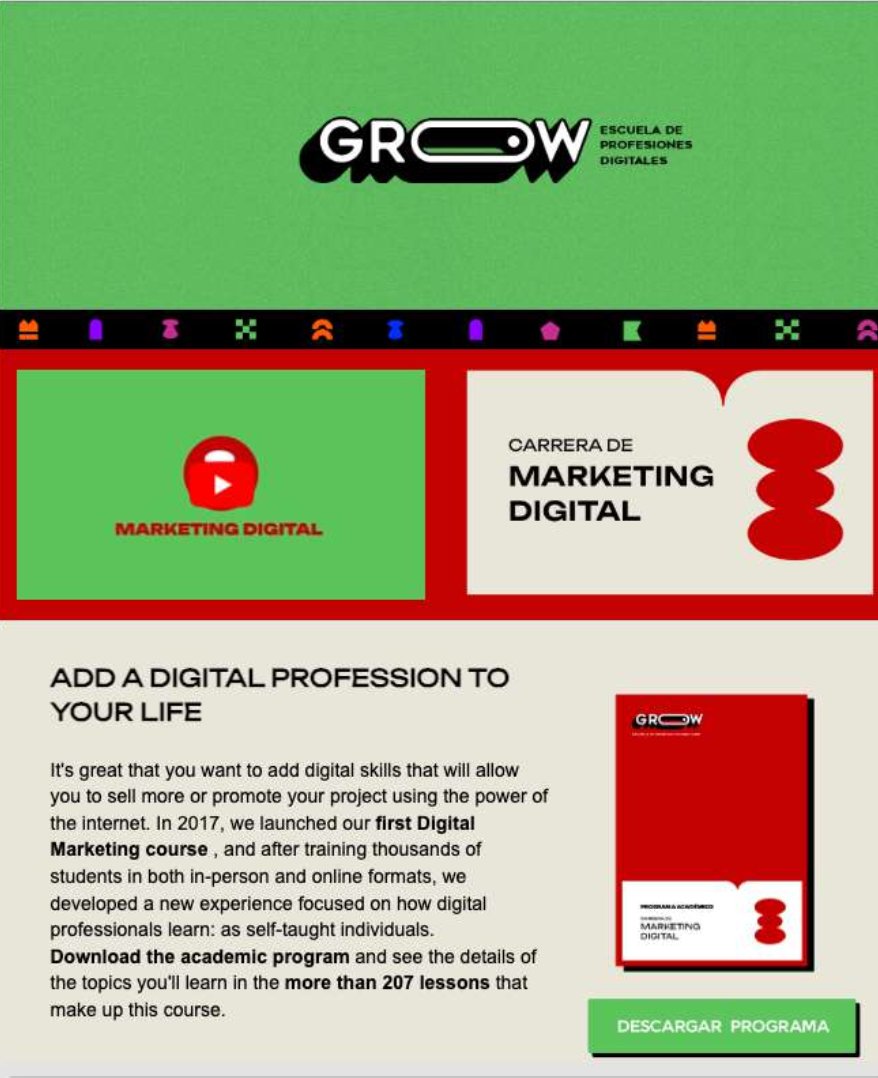
Day 0 as a subscriber received it. The full pack contains all four emails, the program page, the corporate offer and the closing coupon.
Persuasion gets someone through the door. What they say a year later is a different measurement entirely — and it's the one that decides whether a school grows on word of mouth, which is how most of Grow's students arrived.
Public, unedited, and written over nine years by people with no reason to be generous.
Translated from the Spanish originals, which are public at the links above.
Across nine years I wrote, shot and cut more than a thousand pieces to sell courses. Each video below collects several ads for one course — different angles on the same objection, because the person watching isn’t buying a feeling, they’re buying a Tuesday night for four months. These are some of the best of them.
Concept, script, direction, production with owned and rented gear, and the edit. Not a brief handed to an agency — the same person who wrote the syllabus wrote the ad that sold it, which is the only reason they say anything true about the course.
Roughly five hundred of those were promotional spots filmed with instructors in their own homes during 2021, when nobody could get to a studio.
Whoever writes the program should have to sell it. It keeps the program honest.
Cursá donde pinte — roughly, study wherever you feel like it — was a campaign about the one thing online study actually gives you: it doesn’t care where you are. Every frame was generated. No shoot, no location, no cast.
Generative tools had just crossed the line from toy to usable, so I tested that line myself — on a campaign that had to work commercially rather than impress anyone.
The walkthrough, in English — concept, tools, what worked and what had to be redone by hand.
A compilation of ads built with generative video, image and voice models — made for a live ad account with real money behind them, not as experiments.
Two things came out of this that matter more than the footage. First, the cost of testing an idea collapsed: a concept that used to need a shoot could be on air the same week, which changes what you’re willing to try. Second, applying AI to the ad operation itself — targeting, creative rotation, iteration speed — doubled the school’s monthly revenue, and held that level for five months.
That was the last thing Grow taught me, and it runs straight into the work I do now: the tool only gets interesting once it moves a number somebody cares about.
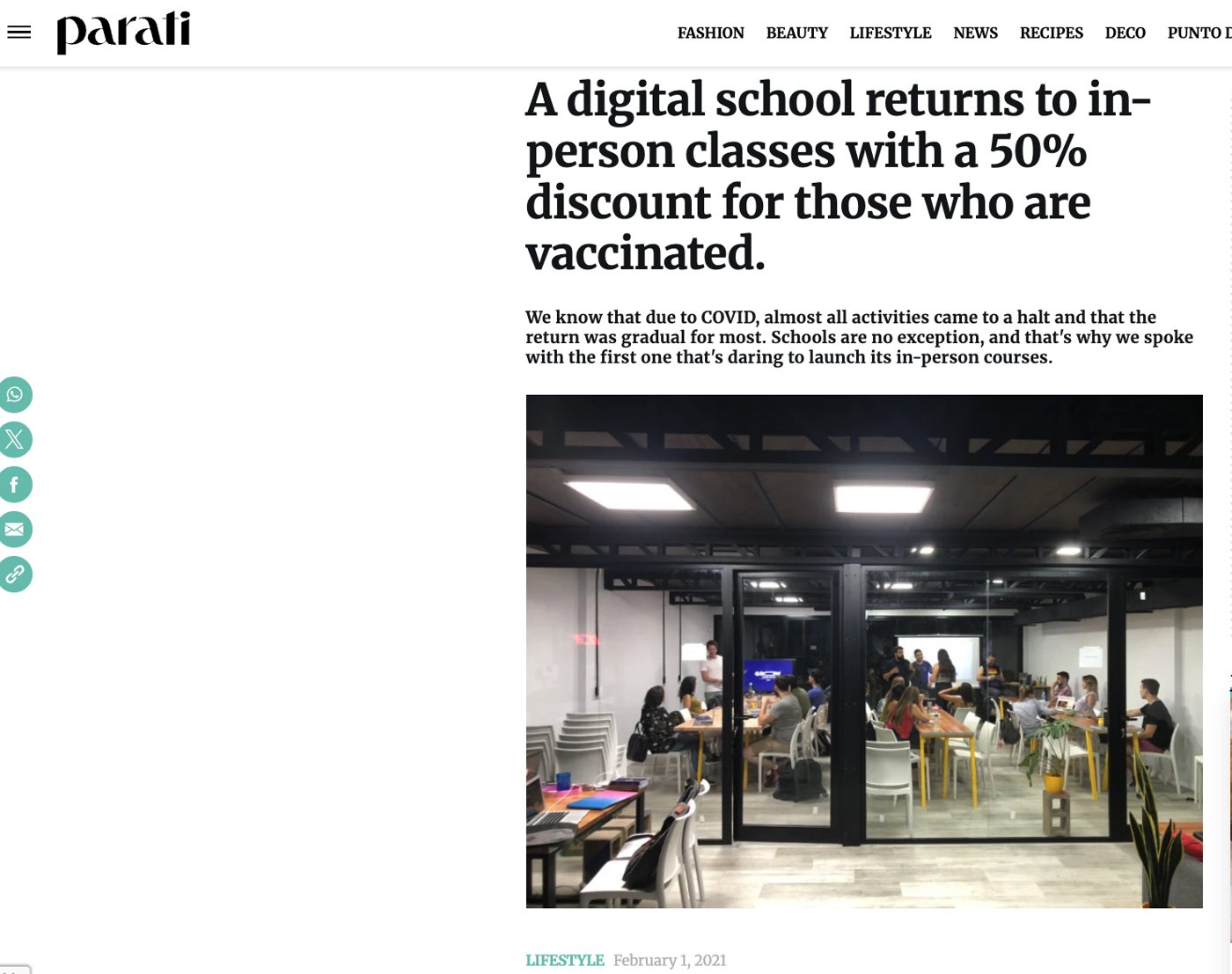
When Argentina first eased its lockdown, in-person classes were allowed on one condition: every second desk left free. Most schools read that as a capacity problem. We read it as a segment — the people who could safely take an empty-desk seat were the ones already vaccinated, so we offered them 50% off.
A national magazine ran the story within days. That's the point of the example: a promotional idea, sharp enough about its moment, bought national coverage that no budget we had could have paid for.
Nine years of running a school in a country in permanent economic emergency produces roughly one of these a month. This is just the one that made the papers. Original coverage, February 2021 ↗