A global food safety certification body, a deeply technical culture, and a decision process built to be slow on purpose. I was hired as a Content Officer. It is now adopting Claude company-wide — on a business case that started as an unsolicited proposal, and I'm leading the rollout.
FSSC certifies that food is safe to eat and that the people making it are treated fairly. The whole product is rigor, and that standard doesn't switch off when the subject changes from a factory to a software tool. When I arrived there was one AI tool available, bundled with the office suite, and effectively nobody used it. The first real conversation I had about AI here ended with the word dangerous — not unreasonable, in a room whose job is risk.
My own position made it harder. After ten years running my own school and my own teams in Argentina, I'd taken an execution-level role in a second language — deliberately, as the fastest honest route into a new market. No budget line, no team, no mandate, no seat where tools get decided. So the problem was never convincing anyone that AI is impressive. It was earning the right to be trusted with it.

Enablement in a conservative organization isn't a delivery problem, it's a permission problem. Each step below was only possible because the one before it had happened.
An organization that certifies other people's rigor is entitled to apply it to itself. My job was to pass the audit, not to complain about it.

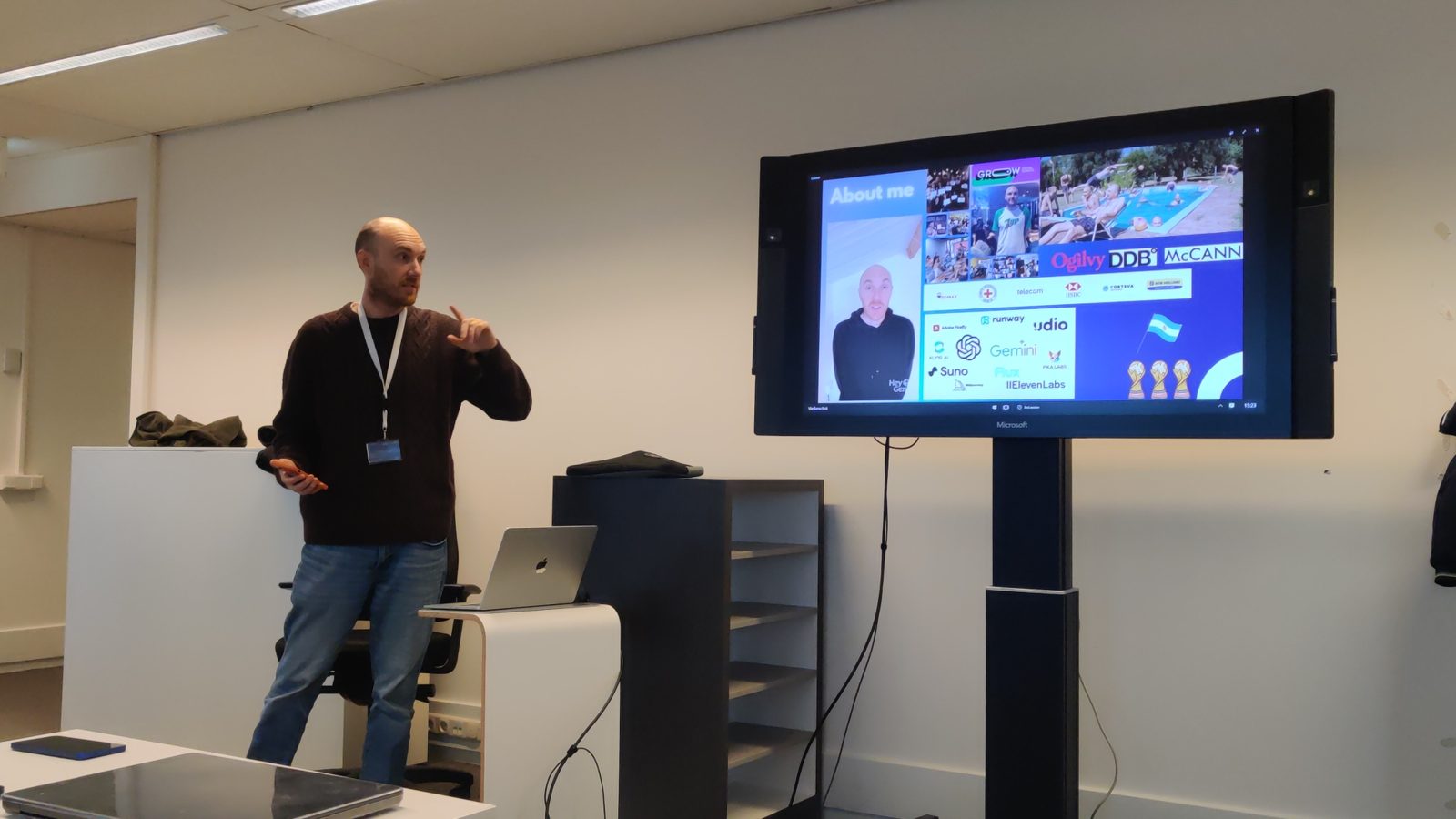
The first workshop — and the first talk I had ever delivered in English, two months after starting four hours a week of lessons. The slide on screen is the opening one: fifteen years of advertising, a school I built, the tools I use daily. With a technical audience you don't get credibility from the topic; you borrow it from work you've already done.
None of these needed permission or a budget. Each one answered a specific objection with something people could look at instead of an argument.
Designing presentations is old. The new thing is prompting them.
I say that to people every time a slide comes back to me for a nudge. It's not a slogan — it's the reasoning that put a presentation tool into the business case.
Three pieces from the approved route — save the date, roll-up banner, session title slide. Built for an event in Japan and designed to carry to every event after it: one system, localized typography, fixed logo lockups, and slots a non-designer can fill without breaking it.
I built it by training a system in Claude Design against our brand manual, so that for the first time the organization can generate assets for every event worldwide with real brand consistency, without a designer in the loop for each one. What I could never have originated from a blank Illustrator file, I solved by directing a model instead. Not being an execution designer stopped being a limit. I always had the vision; now I have the tools to carry it out.
Training started long before approval did. For months the only way to show what the tool does was to sit beside one colleague, on their own work, and rebuild one task with them — one whose week is writing and analysis, one whose week is visual production. One person at a time doesn't scale, but it produces the only thing that does: somebody who can now show a third person. I'm leading the rollout inside Marcom first, then outward to the teams that have already asked to join.
The other half isn't on any process chart. In Spanish I've built communities around projects for fifteen years. In English I'm at the beginning — and still, within a year, I'd become the person in the building people stop to ask about AI, including colleagues well above my level and teams I have no working relationship with. Nobody told them to. That's the part I'm least worried about carrying into the next language.
Fifteen years designing and teaching programs for working adults. A market that now needs people who can make organizations genuinely work differently with AI. And a habit I had long before it was employable: learn a tool obsessively, use it on real work until I know where it breaks, then teach it. Grow proved I can build the system. FSSC proved I can move one through an organization built to resist it, in a second language, with no authority attached.
Whether the title says AI Enablement or L&D is mostly a question of the org chart. The work is the same: find out what people need to be able to do, build the shortest honest path to it, and stand in the room while they get there.
One caveat, stated plainly: the rollout is early, so this case has no adoption numbers yet — anyone showing you a curve at this stage invented it. The change management is done. The results are the next chapter, and I'd like to run it with the mandate that goes with the work.